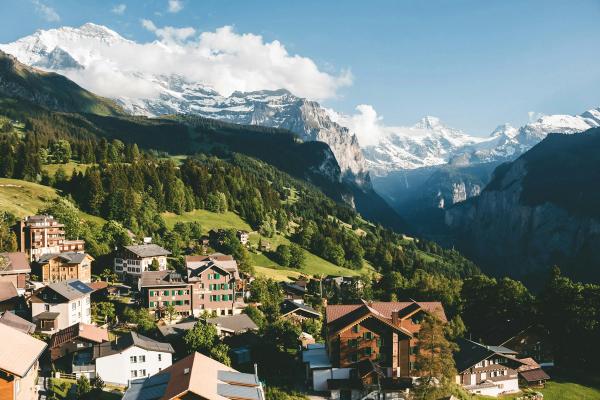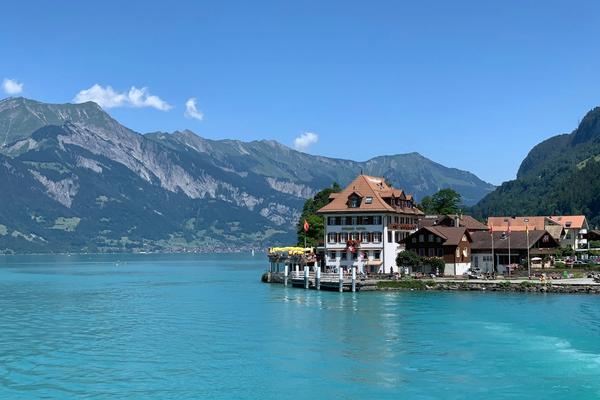

Switzerland is 41,000 square kilometres of geography that refuses to settle on one register. The south is glacier country — the Matterhorn, the Eiger and the Jungfrau rise above valleys that were shaped by ice and are still fed by permanent snowfields. The centre holds the Bernese Oberland, where the vertical rock walls of the Lauterbrunnen valley drop 300 metres to a flat valley floor and 72 waterfalls run off the cliffs. The north opens onto the Swiss Plateau, where the lake cities of Zurich, Lucerne, Geneva and Bern sit at altitudes low enough to feel like Central Europe rather than the Alps. The western arc curves through French-speaking Romandy, where Montreux on Lake Geneva and the vineyards of the Lavaux UNESCO terraces run along the northern shore.
What makes Switzerland work as a travel destination is the infrastructure. The Swiss rail network connects every major city to every mountain resort with a reliability and frequency that makes self-directed travel straightforward — the GoldenPass Panoramic Train from Montreux to Interlaken, the Glacier Express from Zermatt to St Moritz, the rack railway from Grindelwald to Jungfraujoch at 3,454 metres. Cable cars and mountain gondolas extend the network into terrain that roads cannot reach. The country also moves between linguistic zones — German in Zurich and Bern, French in Geneva and Lausanne, Italian in Lugano and the Ticino — which gives each region a distinct character despite the shared geography.
For travellers from Malaysia, Switzerland is best approached as a base for the wider Alpine region — a starting or ending point for tours that move into Italy via Milan, or west into France via Geneva. The country has a small but established halal dining presence in its major cities, particularly Zurich, Geneva and Bern, and the Muslim community is most visible in Zurich's Langstrasse district and around Geneva's Eaux-Vives neighbourhood. The best months to visit depend on what you are there for: snow and skiing from December to March, alpine hiking and wildflower meadows from June to September, the shoulder seasons of April–May and October for fewer crowds and lower prices.