
Seville was the capital of al-Andalus under the Almohad dynasty in the 12th century, and the city’s two most significant monuments are both products of that period — and of what happened to them after the Christian Reconquista of 1248. The Alcázar, the Moorish royal palace, was taken over and expanded by successive Christian rulers while retaining its Islamic architecture; it is still the official Seville residence of the Spanish royal family. The Cathedral was built on the footprint of the Almohad Great Mosque, and the mosque’s minaret — the Giralda — was converted into the cathedral bell tower. The result is the largest Gothic cathedral in the world, entered through a courtyard of orange trees that was once the mosque’s ablution garden.
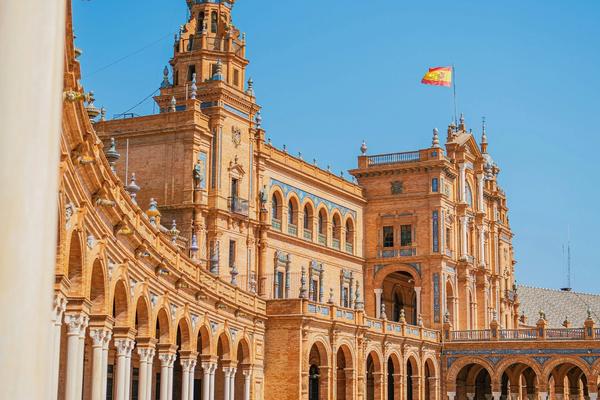
The Plaza de España, a semicircular baroque-Moorish complex built for the 1929 Ibero-American Exposition, is one of the most photographed public spaces in Spain: a canal, a bridge at each end, and 48 ceramic alcoves representing each Spanish province running along the curved arcade. María Luisa Park surrounds it. The Torre del Oro — the 13th-century Almohad watchtower on the Guadalquivir riverbank — is a ten-minute walk south. Triana, the neighbourhood across the river, is where Seville’s ceramic tile tradition and much of its flamenco culture are based; it is worth crossing the bridge for an evening.
The Sevilla Mosque Foundation operates a mosque in the city centre and is included in the Iberian Historia itinerary for prayer time. Halal restaurants are available in the centre, particularly around the Alcázar and the Cathedral area. Seville is one of the hottest cities in Europe in summer — July and August regularly exceed 40°C and the streets empty by midday. March to May and October to November are the two windows when the city is at its most comfortable and most worth visiting.
Best time to visit
March to May and October to November