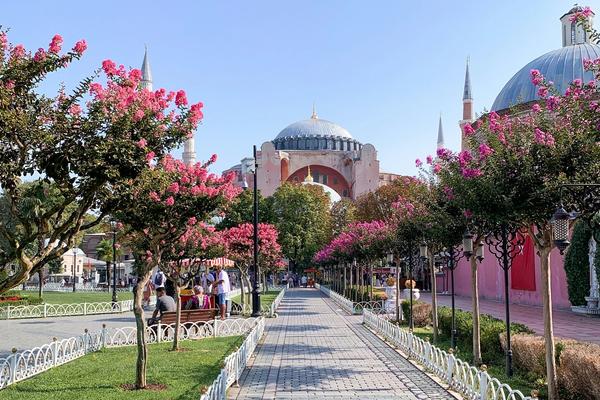

Istanbul has been the capital of the Roman Empire (as Constantinople, from 330 AD), the Byzantine Empire (until 1453) and the Ottoman Empire (until 1922) — three of the most consequential political structures in world history, in sequence, on the same ground. The physical evidence of all three periods is concentrated in the Sultanahmet district on the European side: the Hagia Sophia, built by the Emperor Justinian in 537 AD as the largest enclosed space in the world, converted to a mosque in 1453, converted to a museum in 1934, and reconverted to a mosque in 2020. The Blue Mosque (Sultan Ahmed Camii), built between 1609 and 1616, is directly opposite. The Hippodrome between them was the Byzantine chariot racing track; the Egyptian Obelisk (1450 BC) and the Serpent Column (479 BC) still stand on its original axis.
Topkapi Palace, on the headland above the Bosphorus, was the primary residence of the Ottoman sultans from 1465 to 1856 and administered an empire that at its height stretched from Vienna to the Persian Gulf. The palace complex covers 700,000 square metres and contains the Imperial Treasury, the Harem and the Pavilion of the Holy Mantle, which houses relics of the Prophet Muhammad — one of the most significant pilgrimage sites for Muslim visitors in the city. The Grand Bazaar (Kapalıçarşı), a few minutes’ walk southwest, was founded in 1455 and covers 61 streets with over 4,000 shops. The Spice Bazaar (Mısır Çarşısı) at the waterfront dates from 1664 and sells spices, dried fruit and Turkish delight. The Bosphorus cruise departs from Emineköy and passes the Dolmabahçe Palace waterfront, the Rumeli Fortress and the suspension bridges.
Istanbul is a Muslim-majority city and halal food is the default across all price points. The city’s mosque density is high — the Sultanahmet district alone has the Blue Mosque, the Hagia Sophia and the Eyüp Sultan Mosque (one of the holiest sites in Islam outside the Arabian Peninsula) within walking distance. The Asian side of the city, reached by ferry from Emineköy to Kadiköy in 20 minutes, is less visited by tourists and more representative of how Istanbul actually lives — the Kadiköy market and the Moda waterfront are worth the crossing. The best time to visit is April to June or September to November; July and August are hot (32–36°C) and the Sultanahmet sites are at their most crowded.
Best time to visit
April to June and September to November